A master's is a serious investment. A year or two of your life, tens of thousands in fees, and a move to another country. So the fair question is what you actually get back for it.
In Ireland the answer is unusually clear. The degree is structured around getting you into work, and the employers you want are already here.
The employment numbers
Nine out of ten master's graduates from Irish universities are working within 12 months of finishing. Starting salaries for postgraduates usually land between €40,000 and €60,000 a year. Even at the bottom of that range, two years of work recovers the full cost of a one-year master's with room to spare.
Why Irish degrees lead to jobs
Work is built into the degree. Most master's programmes include internships, industry projects, or placements as a required part of the course, so you graduate with six to twelve months of real experience in your field rather than just a transcript.
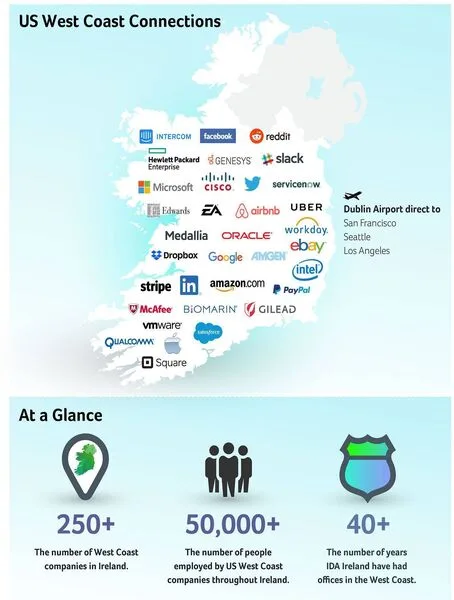
The employers are next door. Google, Meta, Apple, Amazon, Microsoft, Deloitte, PwC, EY, Accenture, Pfizer, and Johnson & Johnson all run major European operations here, often a short commute from campus. Companies recruit straight off Irish campuses, and the firms showing up at career fairs are the ones headquartered and hiring locally. That is the difference between a placement that leads somewhere and one that is just a line on a CV.
The post-study work visa
After you finish, you can stay and work in Ireland for up to 24 months on the Stamp 1G Graduate visa. That is enough time to get hired, build a professional network, and decide what comes next: stay in Ireland, move elsewhere in Europe (the EU access matters), or head home with a CV that travels.
What you can study
Irish universities run master's programmes across every major field. These are the strongest clusters by employer connection and employment rate.
Technology
Computer Science, Data Science, AI, Cybersecurity, Software Engineering.
Business
MBA, Business Analytics, Finance, Digital Marketing, Supply Chain Management.
Pharma & Life Sciences
Pharmaceutical Sciences, Biotechnology, Regulatory Affairs.
Engineering
Mechanical, Electronic, Biomedical, Environmental.
Social Sciences & Humanities
International Relations, Public Policy, Psychology, Education.
The specific programme matters more than the field. A well-placed master's at a university with strong industry ties will beat a higher-ranked programme that has no employer pipeline behind it.
The cost, honestly
Tuition for an Irish master's runs from €10,000 to €30,000 a year. Private colleges sit at the lower end, while established public universities and specialist programmes go higher. Living costs in Dublin average around €1,000 a month for a student, and Cork, Galway, and Limerick come in cheaper.
While you study you can work 20 hours a week, roughly €1,120 a month at the €14 minimum wage, which covers your living costs. So the real number to plan for is the tuition.
| What you pay | Per year |
|---|---|
| Tuition | €10,000–€30,000 |
| Living costs (outside Dublin to Dublin) | €10,000–€12,000 |
| Part-time work offsets, up to | −€13,000 |
| Total for a one-year master's | €20,000–€42,000 |
At a €45,000 starting salary, you break even inside 12 months of working. The maths is not close.
The bottom line
An Irish master's is a year of structured industry exposure in a country where the employers you want are already present, hiring, and wired into the university system. The degree is the reason you go. The career it leads to is the reason it pays off.