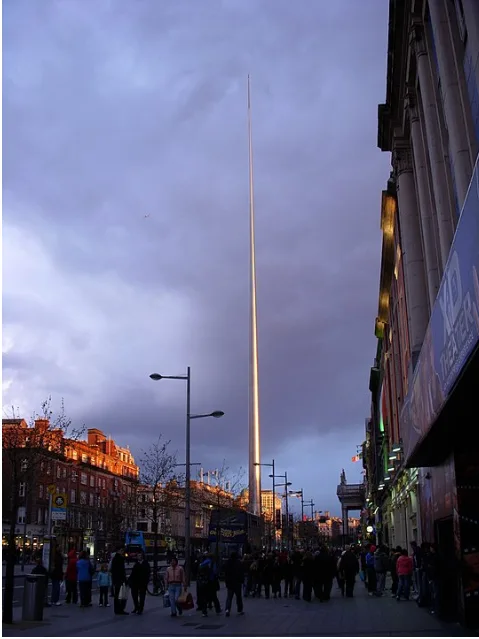
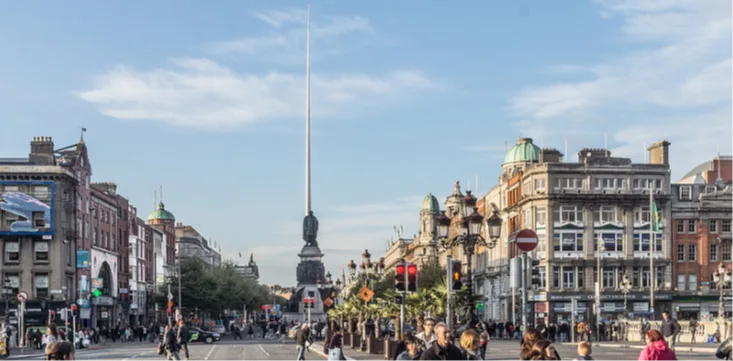
Walk towards Dublin city centre and the first thing you see is a 120-metre steel needle pointing at the sky. The locals call it the Spire. Here's how it got there.
The Spire is 3 metres wide at the base and tapers to 15 centimetres at the tip. The lower 10 metres are highly polished, so on a clear day the street and the people walking past it are reflected back at you. Above that the steel softens; by night, LEDs in the tip light up the skyline.
The top sways in heavy wind — up to 1.5 metres at extreme load. If you happen to be standing underneath when that happens, don't worry. Tall thin structures move; even lamp posts do.
Before the Spire there was a column
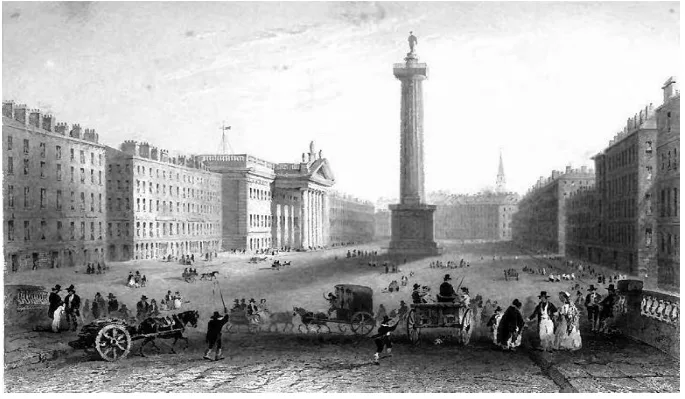
For more than 150 years O'Connell Street had a different monument: the Nelson Pillar, foundation stone laid in 1808, designed by Irish sculptor Thomas Kirk. In March 1966 a bomb reduced it to rubble. The site sat empty for thirty-seven years.
The first proposal to replace it came in the 1970s — a monument to Pádraig Pearse, leader of the 1916 Easter Rising, costed at £150,000 and intended to stand taller than the GPO next door, where Pearse fought. The plan collapsed.
The Pillar Project
In 1988, the year Dublin celebrated its millennium, the city tried again. The Pillar Project brought artists and architects together to design a replacement. Ideas included a "Millennium Arch" with a permanent flame at the top — a Dublin take on the Arc de Triomphe — and a statue of James Joyce, picked as a figure that could not be claimed by politics, religion or military history. None of them got built.
By 1998 the city went international. The brief asked for "a vertical emphasis and elegant structure, related to the quality and scale of O'Connell Street." 205 entries came in. The shortlist was three: two firms in England, one in Dublin. The winner was Ian Ritchie Architects in London.
Building the thing
Construction was meant to finish by 2000. Planning rows and a High Court case pushed it back. The first section finally went up on 18 December 2002; the rest followed in six pieces. The last one was lifted into place on a cold January day in 2003, with thousands watching from O'Connell Street.
Two small details that surprise people: the Spire is also officially called An Túr Solais ("the light tower" in Irish), and despite the polished steel it does not clean itself. A wash every eighteen months. The first one cost around €120,000.
Why it works
The Spire isn't trying to commemorate anyone. There's no general on top, no politician, no saint. That's the point. It's a marker for the city itself — present-tense, deliberately uncomplicated, pointing up. Walk down O'Connell Street in late afternoon and the steel catches the sky. After dark, it lights up. That's about it. And somehow that's enough.
Visiting Dublin to study? We've helped 4,500+ international students settle in here.
Get your free consultation →